BWS: Can you tell us a bit about your background and how you became involved with Body Wisdom Massage School?

A: I started in the restaurant business about 17 years ago and trained as a professional chef in New York City. I worked in restaurants and other establishments for a personal chef company in Des Moines. I had a client who lived off 54th St. One day when I was driving to their house going up 86th St, I looked over. I saw the sign “Body Wisdom Massage Therapy School.” This was significant because, over the six months before that, multiple people had told me I needed to go to massage therapy school just out of the blue. Well, I can take a hint from the Universe and the next person, so I did a little research about Body Wisdom, and on December 22nd, I popped in on my lunch break and talked to G for about half an hour. She gave me all the information and was very kind, and I said I needed to make sure I could manage it financially and I would get in touch when I had my ducks in a row. I left, and she never expected to see me again. 3 months later, I had things sorted out, I called the school and made arrangements to sign up, and on March 22nd, I started classes. I went to school at night, worked full-time during the day, and made it work. It was an excellent learning, growing, and expanding experience, as my personal experiences with bodywork were pretty limited at that time. I met some charming people in the different courses I took, and all of the teachers I experienced were highly skilled, passionate professional therapists who did their very best to instill their experience and knowledge in their students.
I’ve been a full-time therapist since April 2017, and then in 2019, Ali reached out and asked if I’d be interested in teaching, as my name had come up a couple of times. After training with Adam(the prior instructor), I was honored to be asked. I’ve been teaching Clinical Sports and Orthopedic Massage since 2020 and enjoy it immensely. It’s a very theory-heavy course, but it’s also a lot of fun. I try my very best to teach it in an applied-sciences way, it’s also chock-full of great techniques and we also do a lot of hands-on.
In 2021, I filled in teaching the Myofascial Release class, which I do the most in my practice, and I’ll be returning to teach that course again this November(2024) and into the foreseeable future. I love Myofascial Release; it’s a potent technique that applies to almost every client. In my experience, the fascial system is an undertreated aspect of human physiology, and it’s amazing how much benefit the client can receive when someone finally treats the right thing. I also find the principles of the technique itself to carry over into other areas of one’s life, if you want them to, and it’s a very transforming technique to learn and practice.
Last summer, Ali asked me if I would be interested in helping to develop and then teaching a course on Instrument Assisted Soft Tissue Mobilization(IASTM). I agreed, even though I’d never really been that interested in using tools in massage, per se. I trained with Hot & Cold Stones and Bamboo with Dianna Berry, but that was about the extent of it. However, I try to be open-minded about everything, and I’m always up for something new. I also thought it would dovetail in nicely with Orthopedic and Myofascial Release since there are aspects of both in IASTM.
BWS: For those who are unfamiliar with IASTM, can you explain it and how it differs from other massage techniques?
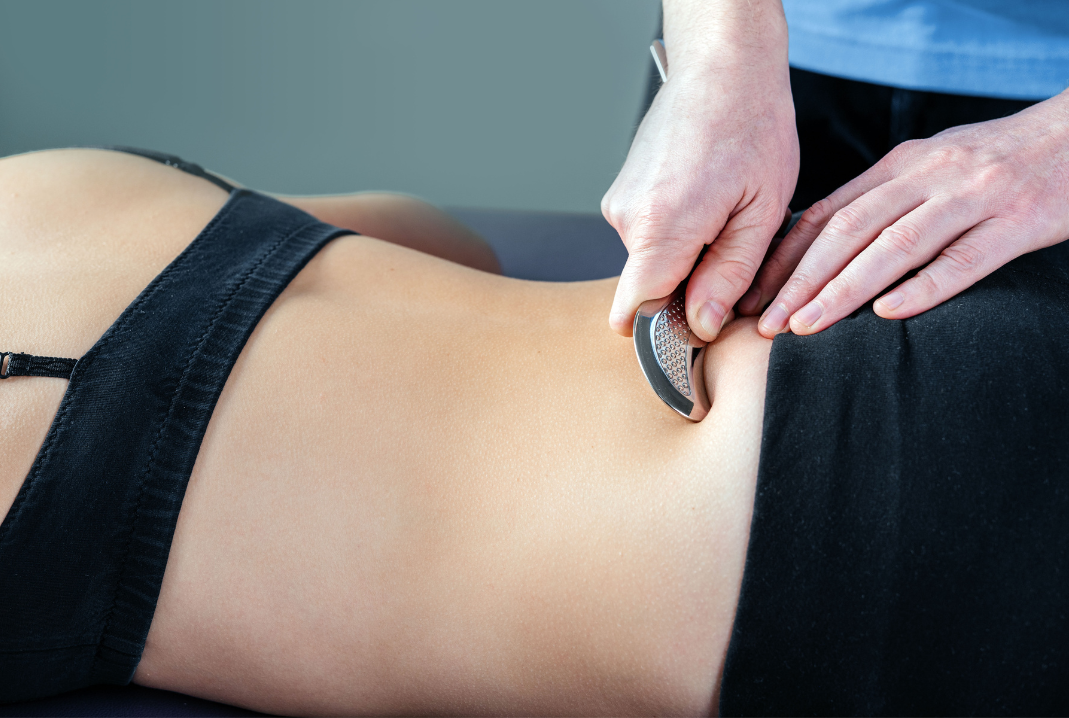
Jillian: It’s essentially what the acronym says, ”Instrument Assisted Soft Tissue Mobilization.” Stainless steel tools are applied to the body in specific ways, with variations in scraping and pressing motions mostly, to mobilize and open the body’s soft tissues, including muscles, tendons, subcutaneous layers, and fascia. Its main difference from the more traditional hands-on techniques therapists are familiar with is the use of stainless steel tools. It’s an excellent technique for saving the therapist’s hands and body because the tool creates some of the pressure and increases the mechanical leverage produced. More effect for the client with less physical work for the therapist, which most therapists will agree is good if you want a long, effective, and pleasant career for yourself. It also provides great feedback on the state of the client’s tissues and, in some ways, is more sensitive even than manual tissue palpation when you get used to it.
BWS: What are some of the critical benefits of IASTM for clients?
Jillian: For the client, it produces quite a pain-relieving effect in soft tissue, particularly connective tissue, much more quickly than other techniques seem to. There are also considerable circulatory effects in releasing stagnation in the tissues, opening space around structures, and decompressing joints, which is very effective and beneficial for the client. There also seem to be some positive effects on bio-energy circulation and transfer. For the practitioner, it’s a great way to release tissues that have resisted other bodywork methods, mainly if you use it as an opening, finishing, or adjunct technique to different types of bodywork.
BWS: Can you share a success story or a particularly memorable experience you’ve had using IASTM?
Jillian: The most memorable experience I’ve had with IASTM was actually from treating myself. I’ve had some trouble off and on for the last 10 years or so, with my left Serratus Anterior muscle locking up and putting pressure on my Long Thoracic Nerve. It is tiresome, to say the least since it locks up my shoulder and makes my neck and hand uncomfortable. I picked up my boomerang tool in a fit of pique and decided, “What the heck! Let’s try this sucker out and see if I can get SOMETHING moving!” So I scraped the dickens out of my left rib cage, up into my axilla, and down my left arm. I could tell something happened afterward, and since it felt beneficial, I went to bed. When I woke up the next day, and by the time I went to work that afternoon, the pain and pressure in my torso, shoulder, hand, and neck were gone. I have had no trouble with it since then, probably 8 or 9 months ago. It’s a good technique.

BWS: How do you envision incorporating IASTM into your practice, and for what clients or conditions do you find most effective?
Jillian: I like to use it as an adjunct technique for my more athletic clientele and a speed-up-the-process technique with my Myofascial Release clients, as it provides me with another way into the client’s tissues. I find it’s well worth taking the 5 minutes to treat a problem area with IASTM, create some space in the tissue matrix and relieve symptoms to an extent, then go in and treat deeper and slower with Myofascial Release or other techniques to give the client a more lasting result and/or take us down to the next layer of their tissue dysfunction. I also find it blends beautifully with Thai massage and Acupressure since the type of tissue mobilization positively affects the conductivity of meridians/sen lines in the body and makes pressure point techniques more effective. It’s also great for chronic connective dysfunction, plantar and palmar surface issues, etc. I also self-treat a lot with it. I’ve had some tibial torsion in my right lower leg, and I’ve noticed that I can improve the tracking of my right patella and leg stride when I treat myself with IASTM. I hope to eventually resolve the issue entirely and save my knee and ankle much trouble and pain further down the line.
BWS: How do you see students who complete your IASTM course using this modality in their practices?
Jillian: Frequently, I hope. All kidding aside, it’s an excellent technique for clients with all sorts of issues. You can do this on anybody if the skin integrity is excellent and appropriate precautions are utilized. I hope that even if it takes some time to feel entirely comfortable with the tools, students who complete the course will at least self-treat, as the self-treatment aspects cannot be overemphasized. It’s a great way to get the feel of the tools if you need to get more comfortable treating clients, minimize injury by keeping your tissues open, speed recovery if you do get injured, and generally keep yourself feeling great as a therapist so you can provide outstanding care and assist your clients in their journeys.
BWS: Are there any particular tips or advice you would give students new to IASTM who want to integrate it into their services?
Jillian: Work on yourself. “Don’t do anything to anyone you haven’t experienced or don’t do to yourself.” AND “Let the tool do the work, so less is more in terms of pressure and time in a specific area. “
BWS: How do you see the field of massage therapy evolving with the integration of modalities like IASTM?
Jillian: I hope to see more mainstream integration of massage therapy and manual bodywork within Physical Therapy and conventional Western Medicine. Hands-on therapies are not valued by Western Medicine in the way that they could, or should, be, exceptionally since even if we cannot “fix” the problem, we can generally provide some symptom relief, and we don’t harm or injure that is not something that most aspects of conventional medicine and therapy can say.
I hope that the adoption of IASTM and other more medically perceived therapies opens the door for a wider acceptance of qualified bodyworkers to operate more in the beginning stages of assessment, care, and treatment rather than the “when everything else has failed, and now I’m so desperate for relief I’ll try anything” stage which is when we typically see people. Speaking for myself, I can do a lot more for the client if I can catch them in the first stages of their dysfunction before they’ve developed tons of compensation patterns, fascial bracing, habitually held pain, etc.
BWS: What are your hopes for the future of IASTM and its impact on the massage therapy community?
Jillian: I hope the technique becomes more widely known in the community of hands-on therapists for its effective technique. I freely admit to having been a bit of a skeptic, maybe a prominent skeptic, about how good a tool-based modality could actually be. It turns out it is pretty darn good and effective. I also hope that therapists understand the need to get properly trained in a modality before offering it because incomplete information is, at best, unhelpful to the client and, at worst, could be physically injurious. Incomplete information or training is also harmful to the reputation of a technique. It puts people off receiving something that could make a massive difference in their state of health and being. Whatever modality you are using, please get the proper education, understand why you’re doing whatever you’re doing, and thoroughly understand any health and safety considerations for the sake of the client, your practice, and yourself.
BWS: Is there anything else you’d like to share about IASTM, your teaching approach, or your experiences at Body Wisdom Massage School?
Jillian: I’d like to say that I’m always honored to teach a class of whatever modality. I truly enjoy meeting students at Body Wisdom and being part of their journey. My goal is always to provide and facilitate the type of experience I was privileged to enjoy as a student at Body Wisdom, and I’m grateful to Ali for allowing me to be part of that.

Also, I am so grateful for a piece of advice I got when I was just starting out in the world: “You’ll know you’re in the right job if you like what you do so much that you would do it for free.” I can honestly say that that’s entirely true. I like what I do so much that I’d do it for nothing.
I hope the students who come through Body Wisdom enter their practices feeling that same way and stay feeling that way. If my fellow teachers and I do our jobs properly, they will have a better chance of attaining that goal.
Best of luck to all my fellow massage therapists,
IASTM 16-hr CE Course Oct 7-8, 2024
Please reserve your spot now and join us on this transformative journey!
Contact G. Kelly M-F 9-5PM at 515-727-4890
or G.Kelley@bodywisdomschool.com
Jillian Peet
Course Details:
https://bodywisdomschool.com/academic-programs/electives/instrument-assisted-soft-tissue-mobilization/
 Body Wisdom Massage School's Blog
Leave a comment