Body Wisdom Teacher Diane Goodson teaches her extremely popular 50-Hour Positional Release Therapy course.
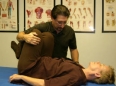
The Position of Release for the Psoas
Positional Release (PR) is an indirect technique to relieve muscular tension and reestablish a pain-free range of motion in joints. PR is based on the principle of the “Position of Release,” where the massage therapist skillfully moves the muscle and joint into a position of greater comfort that eases the client’s pain and holds it until a full release of pain and tension occurs in the body and proper pain-free movement has been restored. The position of release, which allows the muscle to “reset” itself, may be held for up to a couple of minutes or more, but the release most often occurs within 10-20 seconds. Since there is no force required whatsoever from the client, Positional Release (PR) works as if by magic to relieve pain, joint hypo mobility, facial tension, and protective muscle spasms where other more forceful techniques have failed. For the practicing massage therapist, PR offers yet another technique that is easy on the hands and wrist, preventing overuse injuries and, at the same time, addresses a wide range of soft tissue dysfunctions that therapists see on a daily basis.
Definition of Positional Release (from Squidoo)
Positional Release is a highly effective technique that helps reduce pain and restore function to muscles, bones, and joints. In positional release, the most comfortable position resets the sensors in the musculature and joints, known collectively as the proprioceptors. With the correct stimulus to these sensors, the musculoskeletal system returns to a healthier state, eliminating pain and allowing joints to move back to dynamic balance.
History of Positional ReleasePositional release began in the 1950s when Lawrence Jones, D.O., discovered by accident that when he placed the body into a specific comfortable position, pain and dysfunction would heal quickly and completely.
In 1954, Lawrence Hugh Jones, DO, FAAO (1912-1996) made an observation that led to the development of his Strain and Counterstrain Technique. A graduate of the College of Osteopathic Physicians and Surgeons in California in 1936, Dr. Jones was running a successful practice in Oregon when he attempted to treat a patient who had been suffering with back pain for two and a half months. After six weeks of treatment, the patient had not improved. The patient was unable to sleep for more than 15 minutes at a time.
Dr. Jones spent one visit only attempting to find a comfortable position for the patient. He passively put the patient in a variety of positions until he “achieved a position of a surprising amount of comfort, the only benefit he had received in four months’ treatment.” Afterwards, Jones began to experiment with this discovery.
He initially called this approach to pain “Spontaneous Release by Positioning” and later Strain an Counter Strain®. Eventually, variations of his work became known collectively as “positional release.”
There are some differences in the application of Positional Release, particularly among Osteopaths, Physical Therapists, and Massage Therapists. Some practitioners have developed their own versions and have different variations on the name of the work.
Please let me know what you are thinking by commenting on this post.

Rhett Hatfield, Owner/Director of Education Body Wisdom School
“900-1300 Massage Therapist Certification Programs, 5 Different Career Tracks.” Create your “custom massage certification program” of anywhere from 900-1300 hours of world-class massage and bodywork education. CEU Programs are available!
 Body Wisdom Massage School's Blog
Leave a comment